Description
Product Overview
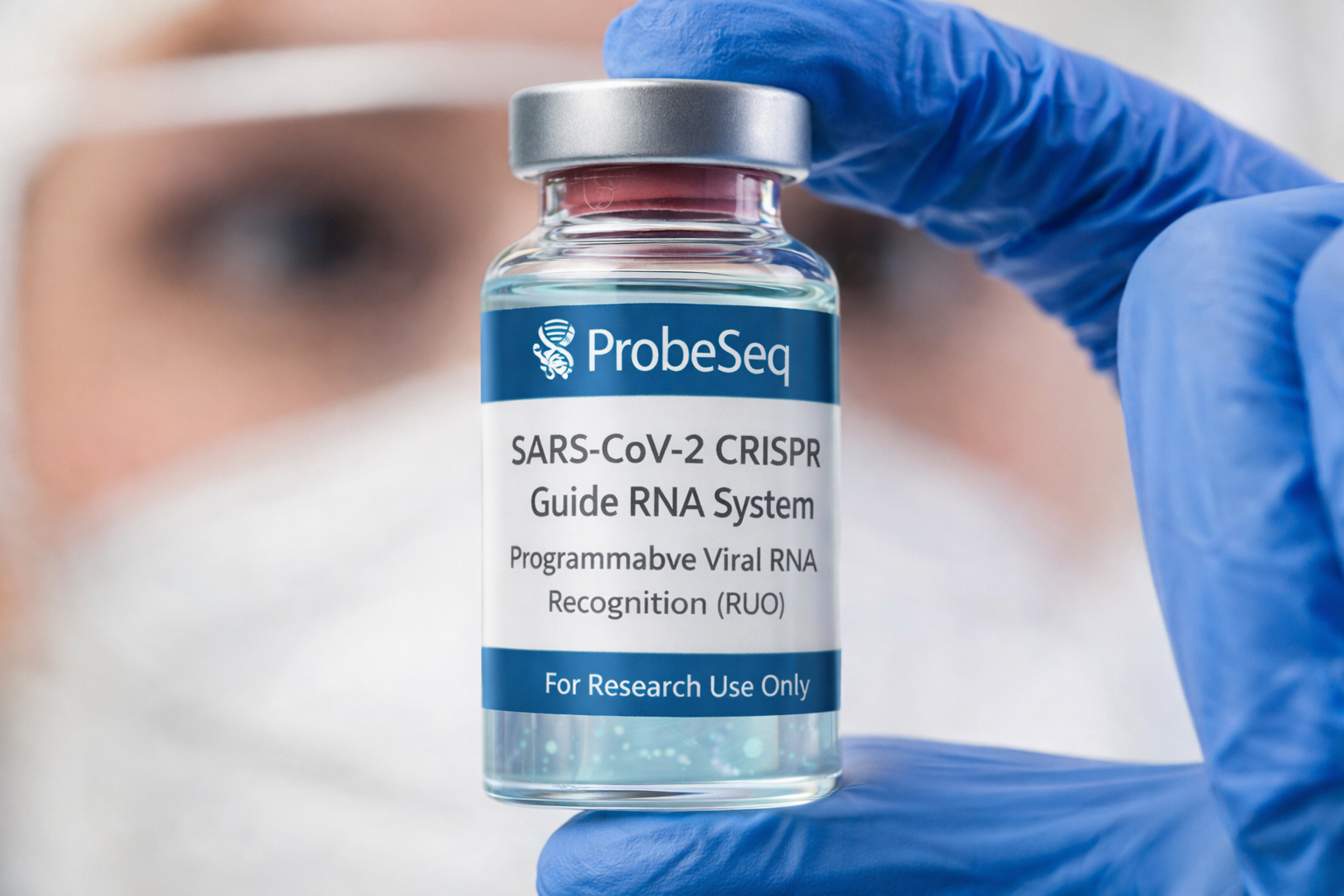
The ProbeSeq SARS-CoV-2 CRISPRDetect™ Guide RNA System enables programmable molecular recognition of viral RNA through CRISPR–Cas–mediated target activation. The product provides sequence-optimized guide RNA constructs designed to direct Cas enzymes toward conserved SARS-CoV-2 genomic regions, enabling highly specific nucleic acid detection and signal generation.
This system supports development of rapid viral detection workflows, portable diagnostic technologies, and automated sample-to-answer platforms. Guide RNAs are engineered for strong target hybridization kinetics, efficient Cas activation, and robust performance across fluorescence, electrochemical, and lateral-flow readout systems.
Molecular Detection Mechanism
Target recognition occurs through CRISPR guide RNA hybridization to complementary viral RNA sequences. Upon binding, the Cas enzyme undergoes conformational activation, initiating catalytic activity and triggering reporter cleavage or signal generation. The activated system produces measurable outputs through fluorescence, electrochemical, or visual detection methods.
The system supports direct detection or amplification-assisted workflows. When combined with RT-LAMP or recombinase polymerase amplification (RPA), detection sensitivity can reach very low target copy numbers.
Target Design Strategy
Guide RNA sequences are selected from conserved SARS-CoV-2 genomic regions including nucleocapsid (N), ORF1ab, and envelope (E) gene targets. Design optimization ensures high sequence specificity, mismatch discrimination, thermodynamic stability, minimal cross-reactivity with related viruses, and compatibility with multiplex detection systems. Variant-specific probe design and custom targeting services are available.
Assay Workflow Integration
The CRISPRDetect™ system supports flexible workflows including RNA extraction or crude sample processing, optional nucleic acid amplification, CRISPR reaction assembly, and signal readout through compatible detection platforms. Typical reaction input volumes range from approximately 5–20 µL depending on system configuration.
System Components
Sequence-validated CRISPR guide RNA probes, target sequence documentation, recommended reaction conditions, reporter compatibility guidance, and handling instructions are included. Custom multiplex panels and variant-specific probe development are available upon request.
Platform Compatibility
Compatible with Cas12 and Cas13 detection systems, fluorescence reporter assays, electrochemical nucleic acid sensors, lateral-flow detection formats, microfluidic cartridge platforms, automated diagnostic devices, and portable point-of-care systems. Guide RNA architecture supports integration with lab-on-chip and capillary-driven microfluidic workflows.
Performance Characteristics
High sequence selectivity, rapid target recognition kinetics, low background activation, stable performance under isothermal conditions, and multiplex capability support development of sensitive molecular detection assays. Performance characteristics depend on enzyme selection and assay configuration.
Technical Specifications
Detection target: SARS-CoV-2 genomic RNA
Enzyme compatibility: Cas12 / Cas13 systems
Format options: Lyophilized or RNase-free solution
Typical concentration range: 10–100 µM
Storage condition: –20 °C recommended
Quality Assurance
Sequence verification, purity assessment, functional activity testing, RNase contamination control, and manufacturing quality review are performed for each production batch. Certificate of Analysis available upon request.
Research Applications
CRISPR diagnostic assay development, rapid viral detection technologies, respiratory infection testing research, biosensor engineering, microfluidic molecular diagnostics, environmental surveillance, and point-of-care nucleic acid testing platforms.
Storage and Handling
Store at –20 °C under RNase-free conditions. Lyophilized format provides enhanced stability. Avoid repeated freeze–thaw cycles for solution format.