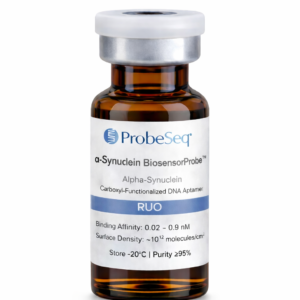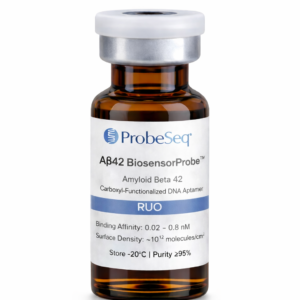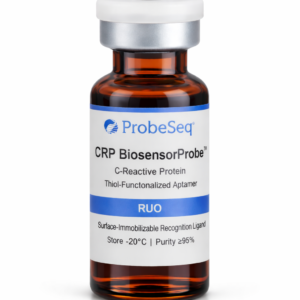

Description
Surface-functional biosensor recognition ligand designed for selective detection of Brain-Derived Neurotrophic Factor (BDNF), supplied as a carboxyl-modified DNA aptamer for covalent immobilization onto amine-functionalized sensor surfaces using EDC/NHS chemistry. Engineered for stable probe orientation, high binding specificity, and long-term integration into electrochemical and microfluidic biosensor platforms. For Research Use Only (RUO).
Product Description
The ProbeSeq Brain-Derived Neurotrophic Factor BiosensorProbe™ is a carboxyl-functionalized single-stranded DNA aptamer engineered for selective recognition and capture of BDNF, a neurotrophin essential for neuronal survival, synaptic plasticity, memory formation, and brain repair. The probe incorporates a terminal carboxyl (–COOH) functional group enabling covalent amide bond formation with primary amine-functionalized sensor surfaces via carbodiimide (EDC/NHS) activation.
BDNF is a secreted growth factor (~27 kDa homodimer) present in serum typically at 5–30 ng/mL and altered in neurological disorders, depression, traumatic brain injury, and neurodegeneration. The BiosensorProbe™ enables quantitative detection across physiologically relevant concentration ranges.
The probe supports stable covalent surface attachment, controlled probe orientation, and high surface density (~10¹² molecules/cm²) for reproducible biosensor performance and long-term monitoring.
Recognition Mechanism
Target recognition is mediated by a sequence-engineered single-stranded DNA aptamer (~40–80 nucleotides) forming a selective three-dimensional binding structure recognizing BDNF epitopes through hydrogen bonding, electrostatic interactions, and conformational complementarity.
Binding affinity (Kd): 0.05–1 nM
Detection range: pg/mL to ng/mL
Association kinetics: seconds to minutes
Reversible binding suitable for quantitative monitoring
Specificity and Selectivity
The BDNF BiosensorProbe™ demonstrates strong selectivity toward BDNF with minimal cross-reactivity toward related neurotrophins including NGF and NT-3.
Cross-reactivity: <5% vs related neurotrophins
Non-specific adsorption reduction: >90%
Matrix compatibility: serum, plasma, cerebrospinal fluid, and cell culture media
Molecular Format and Functionalization
Synthetic single-stranded DNA aptamer containing terminal carboxyl functional group.
Aptamer length: ~40–80 nucleotides
Functionalization efficiency: ≥95% COOH incorporation
Purity: ≥95% (HPLC verified)
End modification: 5′ C6-carboxyl linker
Buffer formulation: nuclease-free buffered solution
Surface Immobilization Chemistry
Carboxyl group enables covalent amide bond formation with amine-functional surfaces.
Activation chemistry: EDC/NHS coupling
Coupling efficiency: >85%
Bond type: covalent amide linkage
Immobilization time: 20–60 min
Operating pH after immobilization: 6.0–8.0
High stability under continuous flow conditions
Compatible Sensor Surfaces
Amine-functionalized polymer surfaces
Aminated graphene and carbon electrodes
Silicon oxide and glass substrates
Microfluidic polymer chips
Hydrogel biosensors
Paper-based analytical devices
Performance Characteristics
Binding affinity: 0.05–1 nM
Surface coverage: ~10¹² molecules/cm²
Operating temperature: 4–45°C
Low probe desorption
Stable signal response
Stability
Shelf stability: ≥12 months at −20°C
Working stability after immobilization: ≥21 days
Resistant to shear and washing cycles
Storage
Store at −20°C in supplied buffer. Avoid repeated freeze–thaw cycles. Protect from light.
Applications
Neuroplasticity monitoring
Brain injury recovery studies
Depression biomarker research
Neurodegeneration monitoring
Electrochemical biosensor development
Microfluidic neurological diagnostics