Description
Product Overview
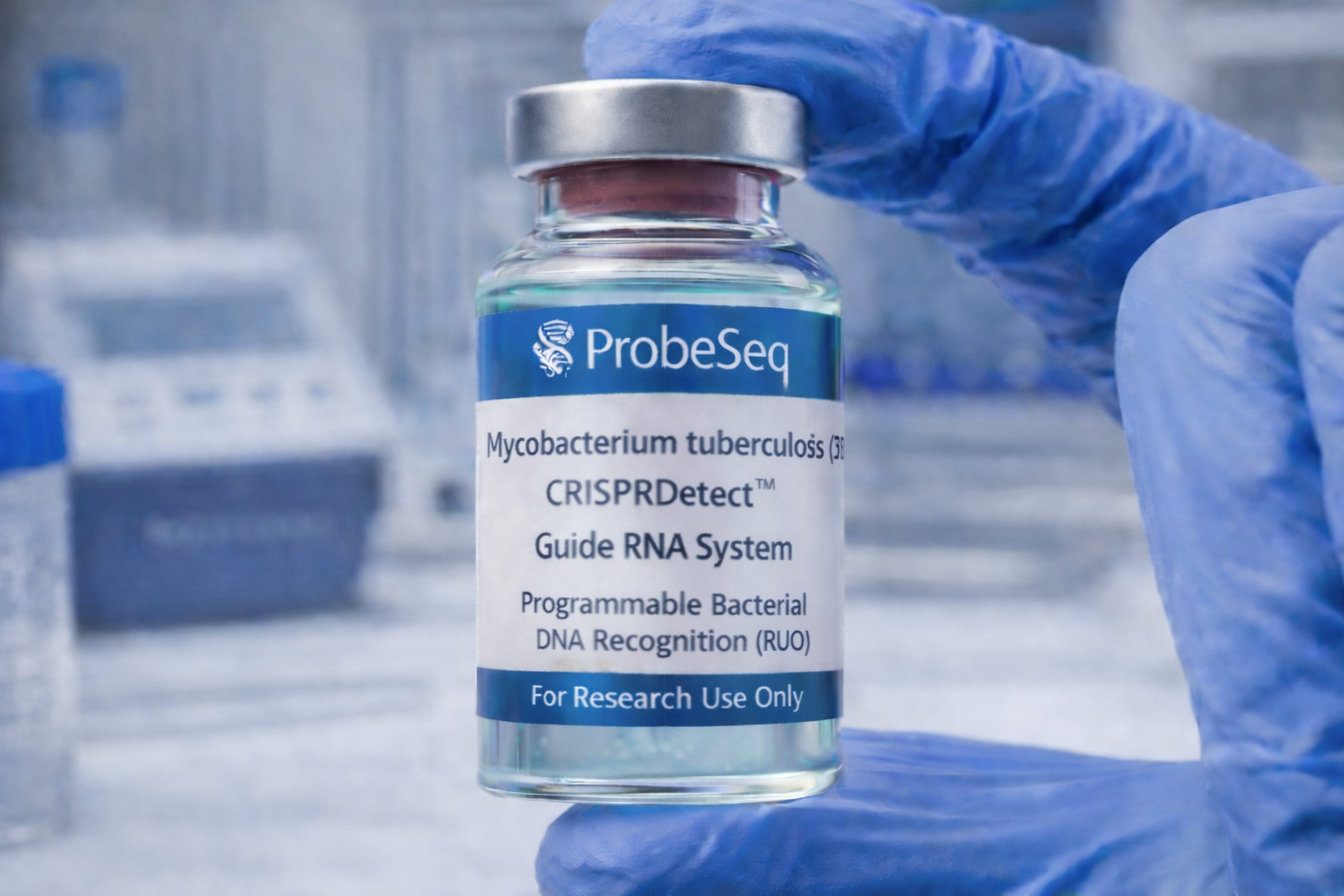
The ProbeSeq TB CRISPRDetect™ Guide RNA System provides validated CRISPR guide RNA constructs for programmable recognition of Mycobacterium tuberculosis DNA. The system targets conserved genomic regions of the pathogen to enable highly specific nucleic acid detection and rapid signal generation for molecular diagnostic development.
The system supports development of infectious disease diagnostic platforms, antimicrobial resistance detection research, point-of-care diagnostic technologies, microfluidic molecular detection systems, and CRISPR biosensor platforms. Guide RNAs are engineered to ensure strong target hybridization, efficient Cas enzyme activation, and stable performance across fluorescence, electrochemical, and lateral-flow detection formats.
CRISPR-Based Detection Advantages
CRISPR-based molecular detection provides a highly specific and programmable alternative to conventional nucleic acid detection methods such as PCR and antibody-based assays. Unlike traditional amplification techniques that require complex thermal cycling and laboratory infrastructure, CRISPR systems enable rapid, isothermal detection with single-nucleotide specificity and strong mismatch discrimination. Cas-mediated signal amplification generates high sensitivity while reducing false positives and background noise. CRISPR detection targets pathogen genetic material directly and enables rapid assay redesign for emerging strains or resistance mutations. The programmable nature of guide RNA design also supports multiplex pathogen detection and seamless integration with portable biosensors and microfluidic diagnostic platforms.
Molecular Detection Mechanism
Target recognition occurs through CRISPR guide RNA hybridization to complementary M. tuberculosis nucleic acid sequences. Upon target binding, Cas enzyme activation triggers collateral cleavage of reporter substrates or signal molecules, producing measurable detection output.
The system supports direct nucleic acid detection or amplification-assisted workflows. When combined with isothermal amplification methods such as LAMP or recombinase polymerase amplification (RPA), detection sensitivity can reach very low copy numbers. Guide RNA design promotes stable Cas complex formation while minimizing non-specific activation.
Target Design Strategy
Guide RNA sequences are selected from conserved M. tuberculosis genomic regions such as IS6110 insertion sequence, rpoB gene, and 16S rRNA gene segments to ensure robust detection across clinical isolates.
Design optimization prioritizes high sequence specificity and mismatch discrimination, minimal cross-reactivity with non-tuberculous mycobacteria, thermodynamic stability of guide–target hybridization, and compatibility with multiplex respiratory pathogen detection panels. Drug resistance mutation targets are available.
Assay Workflow Integration
The CRISPRDetect™ system supports flexible workflows including nucleic acid extraction or crude sample preparation, optional nucleic acid amplification, CRISPR reaction assembly, and signal readout using compatible detection platforms.
Detection can be performed using fluorescence readers, electrochemical biosensors, lateral-flow systems, or microfluidic devices. Typical reaction input volumes range from approximately 5–20 µL depending on assay configuration.
System Components
Sequence-validated CRISPR guide RNA probes
Target sequence reference documentation
Recommended reaction conditions and buffers
Reporter compatibility guidance
Handling and storage instructions
Custom antimicrobial resistance panels available upon request.
Platform Compatibility
Cas12-based detection systems
Cas13 RNA detection workflows
Fluorescent reporter assays
Electrochemical nucleic acid sensors
Lateral-flow detection platforms
Microfluidic cartridge systems
Automated molecular diagnostic devices
Portable point-of-care testing platforms
Guide RNA architecture supports integration with lab-on-chip and capillary-driven microfluidic technologies.
Performance Characteristics
High sequence selectivity, rapid target recognition kinetics, low background activation, stable performance under isothermal conditions, multiplex detection capability, and scalability for high-throughput assay development. Performance depends on enzyme selection and assay configuration.
Technical Specifications
Detection target: Mycobacterium tuberculosis nucleic acids
Guide RNA length: optimized for Cas system compatibility
Enzyme compatibility: Cas12 / Cas13 platforms
Format options: Lyophilized or RNase-free solution
Typical concentration range: 10–100 µM
Reaction temperature range: assay-dependent
Storage: –20 °C recommended
Quality Assurance
Sequence verification, purity and integrity testing, functional activity validation, RNase contamination control, and manufacturing quality review are performed for each batch. Certificate of Analysis available upon request.
Research Applications
Tuberculosis diagnostic development
Antimicrobial resistance research
Bacterial pathogen detection research
CRISPR biosensor engineering
Microfluidic molecular diagnostics
Point-of-care testing platform development
Global health surveillance studies
Storage and Handling
Store at –20 °C under RNase-free conditions. Lyophilized format provides enhanced stability during transport and storage. Avoid repeated freeze–thaw cycles for solution format.