Description
Product Overview
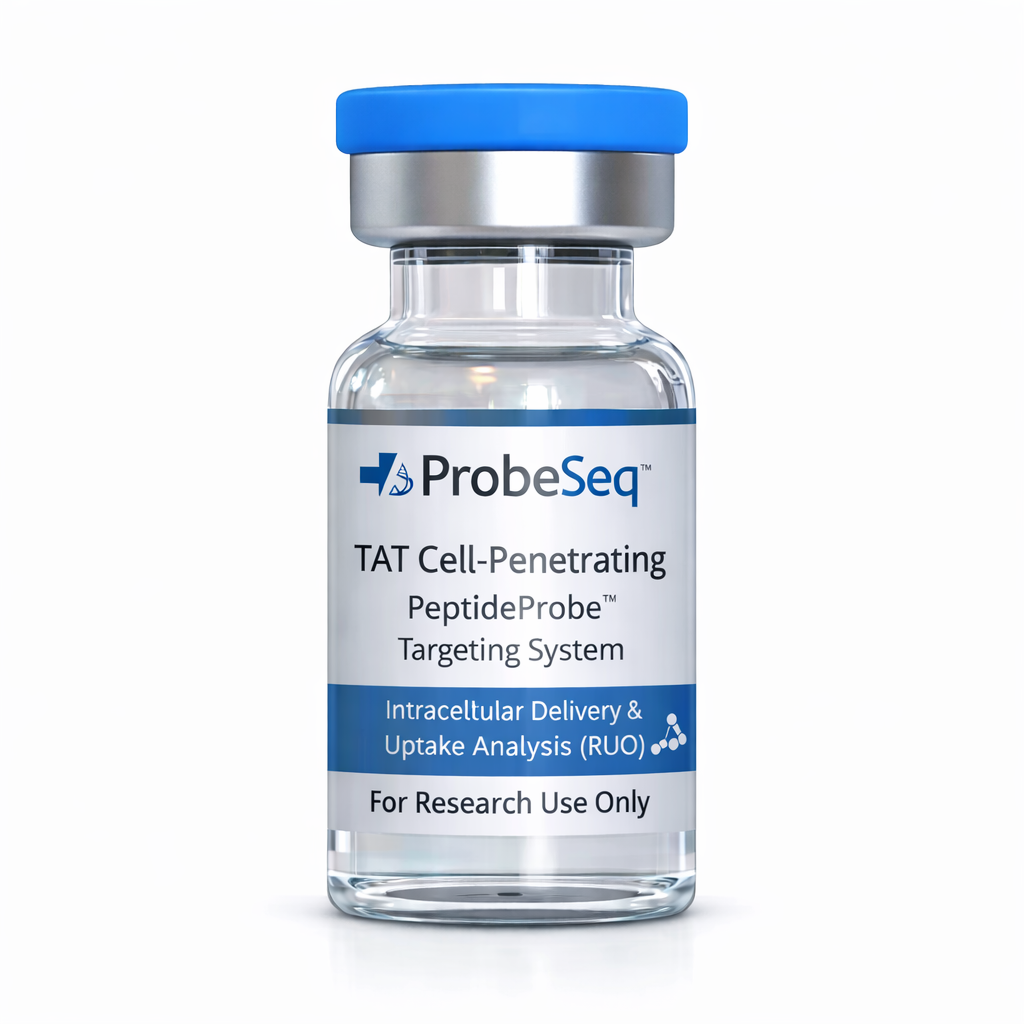
The ProbeSeq TAT PeptideProbe™ System provides sequence-optimized HIV-1 TAT–derived cell-penetrating peptides for efficient cellular internalization and intracellular delivery applications. The system enables quantitative investigation of membrane translocation, intracellular trafficking, and cargo delivery efficiency in live-cell assays.
This product supports research in drug delivery, nucleic acid transport, protein delivery, intracellular biosensing, and therapeutic development. Peptide probes are engineered for strong membrane interaction, rapid cellular uptake, and stable intracellular performance.
The system is compatible with fluorescence imaging, electrochemical detection, microfluidic delivery platforms, and intracellular biosensor technologies.
Peptide Probe Technology Advantages
Cell-penetrating peptides enable efficient delivery across cell membranes without complex transfection reagents. Compared to viral or lipid delivery systems, peptide probes provide rapid uptake, reduced cytotoxicity, tunable conjugation capability, and strong compatibility with biosensor and lab-on-chip technologies.
Molecular Detection Mechanism
TAT peptides interact with cell membrane components and promote energy-dependent and independent uptake mechanisms, enabling translocation of conjugated molecules into cells.
The system supports delivery and detection of fluorescent labels, nucleic acids, proteins, nanoparticles, and biosensor components for quantitative intracellular analysis.
Target Design Strategy
Peptide sequences are optimized for membrane penetration efficiency and intracellular stability.
Design optimization prioritizes:
High cellular uptake efficiency
Rapid membrane translocation kinetics
Minimal cytotoxicity
Stable intracellular localization
Compatibility with molecular cargo conjugation
Reproducible uptake performance
Native and modified TAT peptide variants available.
Assay Workflow Integration
The PeptideProbe™ system supports workflows including cargo conjugation, cell incubation, intracellular imaging, and uptake quantification.
The assay integrates with:
Live-cell imaging systems
Intracellular delivery studies
Gene and protein delivery platforms
Microfluidic cell culture systems
Biosensor delivery workflows
Drug screening assays
System Components
Sequence-validated TAT peptide probes
Cargo conjugation guidelines
Recommended assay conditions
Buffer and handling instructions
Uptake analysis protocols
Custom peptide modifications available upon request.
Platform Compatibility
Fluorescence imaging systems
Electrochemical biosensors
Microfluidic delivery platforms
Intracellular biosensor systems
Lab-on-chip devices
Drug delivery research workflows
Performance Characteristics
High cellular uptake efficiency, rapid membrane translocation, stable intracellular delivery, low cytotoxicity, reproducible performance, and strong compatibility with biosensor platforms.
Technical Specifications
Detection target: Cellular membrane uptake pathways
Probe format: Synthetic cell-penetrating peptide
Sequence basis: HIV-1 TAT derived
Conjugation options: Fluorophore / nucleic acid / protein / nanoparticle
Purity: ≥95%
Storage: –20 °C recommended
Quality Assurance
Sequence verification, purity validation, uptake performance testing, and manufacturing quality review performed for each batch.
Research Applications
Intracellular delivery research
Drug and gene delivery systems
Biosensor delivery and targeting
Cellular uptake studies
Nanoparticle transport research
Microfluidic cell delivery platforms
Storage and Handling
Store at –20 °C in dry conditions. Avoid repeated freeze–thaw cycles. Reconstitute in recommended buffer before use.
For Research Use Only (RUO). Not for diagnostic use.