Description
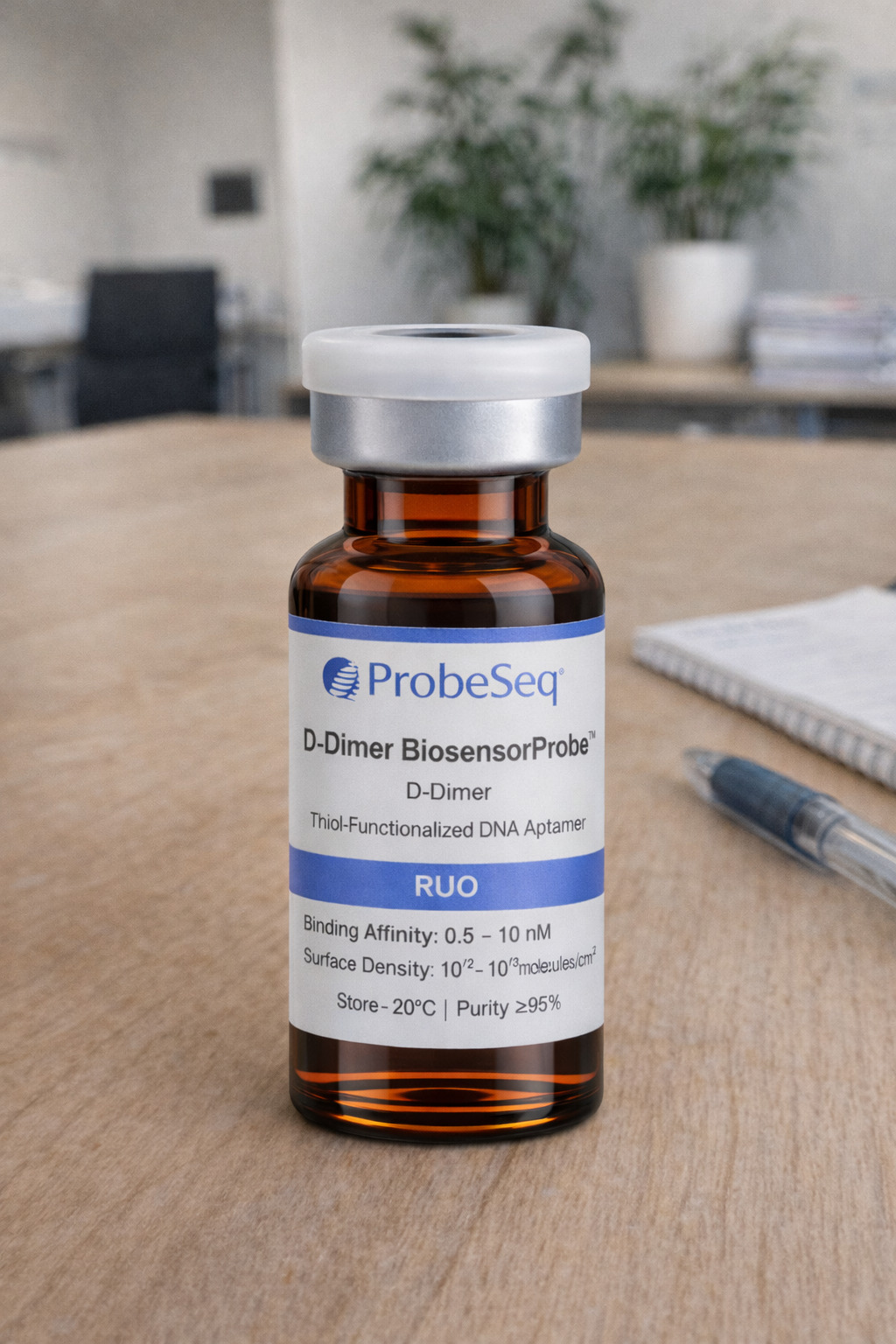
Surface-functional biosensor recognition ligand designed for selective detection of D-Dimer, supplied as a thiol-modified DNA aptamer for direct immobilization on gold and thiol-reactive sensor surfaces. Engineered for controlled orientation, high binding specificity, and stable integration into electrochemical and microfluidic biosensor platforms. For Research Use Only (RUO).
Product Description
The ProbeSeq D-Dimer BiosensorProbe™ is a thiol-functionalized single-stranded DNA aptamer engineered for selective recognition and capture of D-Dimer, a fibrin degradation product widely used as a clinical biomarker for thrombosis, coagulation disorders, pulmonary embolism, and stroke risk assessment. The probe incorporates a terminal sulfhydryl (–SH) functional group enabling controlled covalent immobilization on gold and thiol-reactive sensor interfaces while preserving aptamer folding and target-binding activity.
D-Dimer is a cross-linked fibrin degradation fragment with molecular weight ~180 kDa generated during fibrinolysis. Physiological plasma levels are typically <0.5 µg/mL fibrinogen equivalent units (FEU), while elevated concentrations are associated with thrombotic events and inflammatory conditions. The BiosensorProbe™ enables sensitive surface-based detection across clinically relevant concentration ranges.
The probe is optimized for surface-immobilized sensing environments, enabling dense probe packing (~10¹²–10¹³ molecules/cm² on gold surfaces), controlled orientation, and stable signal generation across electrochemical, optical, and impedance-based detection platforms.
Recognition Mechanism
Target recognition is mediated by a sequence-engineered single-stranded DNA aptamer (~35–70 nucleotides) that undergoes conformational folding upon interaction with fibrin degradation epitopes of D-Dimer. Binding occurs through electrostatic interactions, hydrogen bonding, and molecular shape complementarity.
Typical equilibrium dissociation constant (Kd): 0.5–10 nM
Association kinetics: rapid binding within seconds to minutes depending on surface density
Detection capability: ng/mL to µg/mL range depending on sensor platform
The aptamer maintains structural integrity following immobilization and provides reversible binding suitable for quantitative biosensing.
Specificity and Selectivity
The D-Dimer BiosensorProbe™ demonstrates high molecular specificity toward D-Dimer with minimal cross-reactivity toward fibrinogen, fibrin monomers, and related plasma proteins.
Cross-reactivity: <5% against fibrinogen and serum albumin
Non-specific adsorption reduction: >90% compared to non-functionalized DNA controls
Matrix compatibility: plasma, serum, and whole blood extracts
Sequence-driven recognition targets structural epitopes unique to cross-linked fibrin fragments, enabling selective detection in complex biological samples.
Molecular Format and Functionalization
Synthetic single-stranded DNA aptamer with terminal thiol (–SH) functional group introduced via controlled chemical modification.
Aptamer length: ~35–70 nucleotides
Functional group incorporation: ≥95% thiol modification
Purity: ≥95% (HPLC verified)
End modification: 5′ or 3′ thiol linker (C6 or equivalent)
The probe is chemically stabilized to preserve structural folding and functional group reactivity.
Surface Immobilization Chemistry
The terminal thiol group supports direct immobilization on gold electrodes through formation of self-assembled monolayers via Au–S bonding.
Surface binding strength: ~40–50 kcal/mol Au–S interaction
Typical immobilization time: 30–120 min
Recommended surface density: 1–10 pmol/cm²
Operating pH range after immobilization: 6.5–8.5
Compatible with nanostructured gold, planar gold electrodes, gold nanoparticles, and maleimide-functionalized surfaces.
Compatible Sensor Surfaces
Gold electrodes and nanostructured gold substrates
Gold nanoparticle-modified interfaces
Thiol-reactive polymer coatings
Maleimide-functionalized surfaces
Electrochemical impedance and amperometric sensors
Microfluidic lab-on-chip platforms
Surface plasmon resonance gold chips
Performance Characteristics
Binding affinity (Kd): 0.5–10 nM
Surface coverage: 10¹²–10¹³ molecules/cm²
Operating temperature range: 4–45°C
Low non-specific adsorption on gold surfaces
Stable signal response over repeated measurement cycles
Stability
The D-Dimer BiosensorProbe™ is chemically stabilized to maintain aptamer conformation and thiol reactivity.
Shelf stability: ≥12 months at −20°C
Working stability after immobilization: ≥7–14 days depending on surface conditions
Thermal stability: stable up to ~60°C for short exposure
Storage
Store at −20°C in supplied buffered formulation (10 mM Tris, 1 mM EDTA, pH 7.4 or equivalent). Avoid repeated freeze–thaw cycles and prolonged exposure to oxidizing conditions. Store protected from light.
Applications
Thrombosis and coagulation monitoring
Pulmonary embolism research
Stroke risk biomarker detection
Electrochemical biosensor development
Point-of-care diagnostic device engineering
Microfluidic blood analysis platforms
Multiplex cardiovascular panels