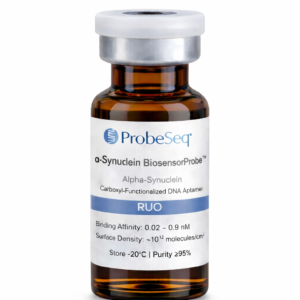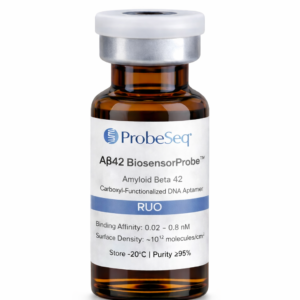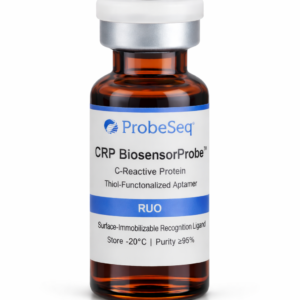

Description
Surface-functional biosensor recognition ligand designed for selective detection of Ubiquitin C-Terminal Hydrolase L1 (UCH-L1), supplied as a thiol-modified DNA aptamer for direct immobilization on gold and thiol-reactive sensor surfaces. Engineered for high binding specificity, controlled probe orientation, and stable integration into electrochemical and microfluidic biosensor platforms. For Research Use Only (RUO).
Product Description
The ProbeSeq Ubiquitin C-Terminal Hydrolase L1 BiosensorProbe™ is a thiol-functionalized single-stranded DNA aptamer engineered for selective recognition and capture of UCH-L1, a neuron-specific cytoplasmic enzyme widely used as a biomarker for neuronal injury, traumatic brain injury, and neurodegenerative disease monitoring. The probe incorporates a terminal sulfhydryl (–SH) functional group enabling stable covalent immobilization on gold sensor interfaces while preserving aptamer folding and binding activity.
UCH-L1 is a neuronal deubiquitinating enzyme (~24.8 kDa) highly expressed in neurons and released into circulation following neuronal cell body damage. Baseline serum levels are typically <0.05 ng/mL and may increase to >0.2–5 ng/mL following traumatic brain injury depending on severity. The BiosensorProbe™ supports ultrasensitive detection across clinically relevant concentration ranges.
The probe enables high-density surface immobilization (~10¹²–10¹³ molecules/cm²), controlled probe orientation, and stable signal generation across electrochemical, impedance, and optical sensing platforms.
Recognition Mechanism
Target recognition is mediated by a sequence-engineered single-stranded DNA aptamer (~40–80 nucleotides) forming a high-affinity binding structure specific to UCH-L1 protein epitopes through hydrogen bonding, electrostatic interactions, and structural complementarity.
Binding affinity (Kd): 0.02–1 nM
Detection range: pg/mL to ng/mL
Association kinetics: seconds to minutes
Reversible binding suitable for quantitative monitoring
Specificity and Selectivity
The UCH-L1 BiosensorProbe™ demonstrates high specificity toward UCH-L1 with minimal cross-reactivity toward other neuronal proteins including GFAP, neurofilament proteins, and tau.
Cross-reactivity: <3% against related neural proteins
Non-specific adsorption reduction: >90% vs non-functionalized DNA
Matrix compatibility: serum, plasma, cerebrospinal fluid, and whole blood extracts
Molecular Format and Functionalization
Synthetic single-stranded DNA aptamer containing terminal thiol functional group.
Aptamer length: ~40–80 nucleotides
Functionalization efficiency: ≥95% thiol incorporation
Purity: ≥95% (HPLC verified)
End modification: 5′ C6-thiol linker
Buffer formulation: nuclease-free buffered solution
Surface Immobilization Chemistry
Terminal thiol enables self-assembled monolayer formation on gold surfaces via Au–S bonding.
Surface binding strength: ~40–50 kcal/mol
Immobilization time: 30–120 min
Recommended surface density: 1–10 pmol/cm²
Operating pH after immobilization: 6.5–8.5
Compatible Sensor Surfaces
Gold electrodes and nanostructured gold substrates
Gold nanoparticle-modified interfaces
Thiol-reactive polymer coatings
Maleimide-functionalized surfaces
Electrochemical biosensors
Microfluidic diagnostic devices
Wearable neurological monitoring systems
Performance Characteristics
Binding affinity: 0.02–1 nM
Surface coverage: 10¹²–10¹³ molecules/cm²
Operating temperature: 4–45°C
Low non-specific adsorption
Stable signal response during repeated measurement cycles
Stability
Shelf stability: ≥12 months at −20°C
Working stability after immobilization: ≥14 days
Thermal tolerance: stable up to ~60°C short exposure
Storage
Store at −20°C in supplied buffer. Avoid repeated freeze–thaw cycles. Protect from oxidation and light.
Applications
Traumatic brain injury detection
Concussion monitoring
Stroke biomarker detection
Neurodegeneration research
Electrochemical biosensor development
Microfluidic neurological diagnostics