Description
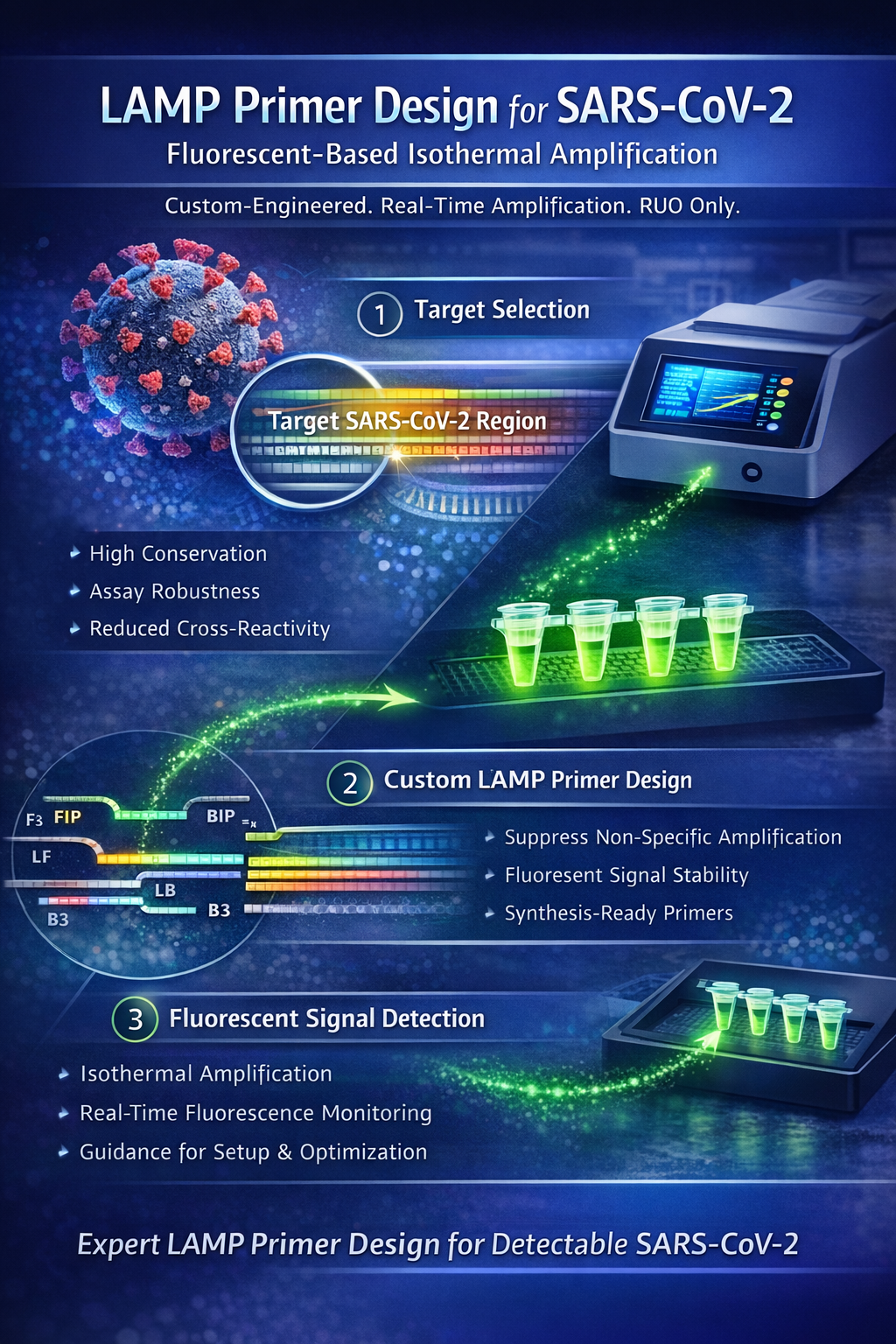
The ProbeSeq SARS-CoV-2 LAMP Primer Design Service is a specialized molecular probe design offering developed for fluorescence-based detection of SARS-CoV-2 RNA using loop-mediated isothermal amplification (LAMP). This service is intended for research teams developing molecular assays, biosensors, and point-of-care platforms that require rapid isothermal amplification combined with interpretable real-time fluorescence signals.
SARS-CoV-2 remains a widely used target in molecular diagnostics research and technology development. While LAMP enables rapid amplification at constant temperature, assay performance is highly sensitive to primer architecture. Suboptimal primer design can lead to non-specific amplification, unstable fluorescence baselines, and late-stage signal artifacts, all of which increase development time and reduce assay reliability. This service addresses these challenges through an engineering-driven design workflow focused on robustness and reproducibility rather than generic sequence generation.
Design Scope
Each design engagement delivers a complete LAMP primer architecture optimized for fluorescence-based detection, including:
-
Outer primers (F3, B3)
-
Inner primers (FIP, BIP)
-
Loop primers (LF, LB)
Primer sets are designed to support rapid amplification kinetics while maintaining stable fluorescence signal development over the reaction time window.
Design Strategy
ProbeSeq applies a structured primer design and screening process that includes:
-
Selection of conserved SARS-CoV-2 target regions with emphasis on assay robustness
-
Thermodynamic balancing of inner and outer primers
-
Evaluation of secondary structure formation and primer–primer interactions
-
In-silico specificity screening against relevant viral sequence backgrounds
-
Design constraints tailored for fluorescence-based signal monitoring
This approach is intended to minimize non-specific amplification and reduce empirical trial-and-error during early assay development.
Fluorescent Detection Compatibility
The designed primer sets are compatible with common fluorescence-based LAMP workflows, including:
-
Intercalating dye–based fluorescence monitoring
-
Real-time signal acquisition using isothermal-capable instruments
-
Portable and custom fluorescence readers
Design parameters can be adjusted to align with reaction temperature limits, time-to-result targets, and platform-specific constraints when provided by the user.
Deliverables
Each design engagement includes:
-
A complete LAMP primer set (F3, B3, FIP, BIP, LF, LB) in synthesis-ready format
-
Primer naming, orientation, and target region mapping
-
Design rationale outlining key constraints and screening considerations
-
Summary of in-silico specificity and interaction analysis
-
High-level guidance for initial assay testing and optimization
Optional extensions such as multiplex planning, iterative redesign based on experimental data, or adaptation for cartridge-based systems are available upon request.
Intended Applications
This service is suitable for research-use applications including:
-
Fluorescent LAMP assay development
-
SARS-CoV-2 method benchmarking and feasibility studies
-
Point-of-care and decentralized testing platform prototyping
-
Microfluidic and cartridge-based assay integration
-
Biosensor development and performance evaluation
Limitations
-
For Research Use Only (RUO)
-
Not intended for diagnostic or therapeutic procedures
-
Final assay performance depends on reaction chemistry, instrumentation, and user implementation