Description
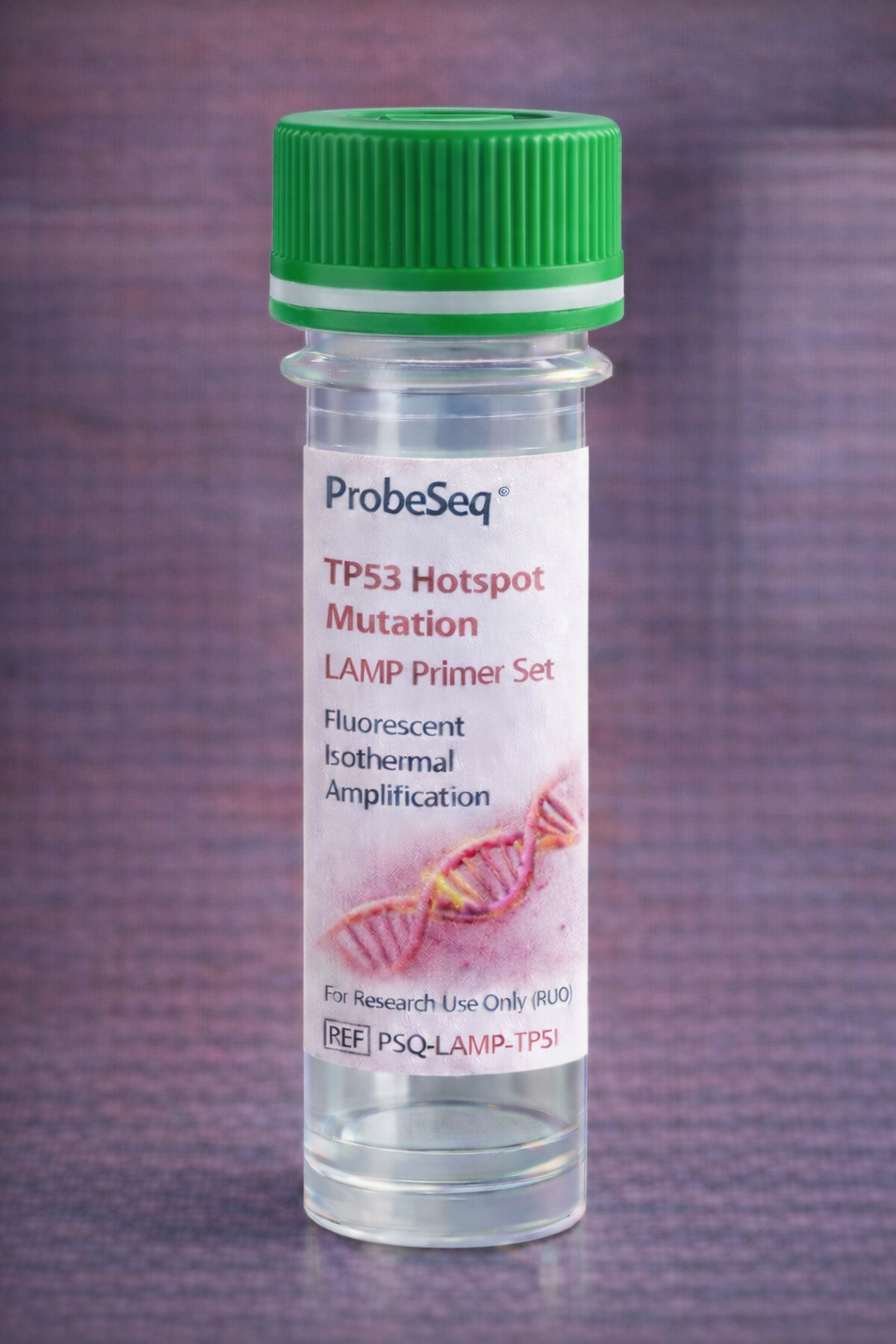
The ProbeSeq TP53 Hotspot Mutation LAMP Primer Set is a mutation-targeted six-primer architecture engineered for fluorescence-based loop-mediated isothermal amplification (LAMP) of clinically relevant TP53 hotspot variants. This product is intended for research-use molecular oncology applications, including mutation detection assay development, liquid biopsy research, and rapid isothermal amplification platform integration.
TP53 is one of the most frequently mutated tumor suppressor genes across multiple cancer types, including lung, colorectal, breast, ovarian, and brain cancers. A significant proportion of oncogenic TP53 alterations cluster within defined hotspot regions of the DNA-binding domain. Rapid and mutation-specific detection strategies are increasingly valuable for translational oncology research and decentralized molecular testing concepts.
This primer system is designed to preferentially amplify selected TP53 hotspot mutation sequences under isothermal conditions, enabling fluorescence-based detection without thermocycling instrumentation. Primer architecture has been optimized to promote selective amplification kinetics and stable fluorescence signal generation while reducing non-specific amplification.
What’s Included
Each set contains a complete LAMP primer architecture for mutation-focused amplification:
-
F3 and B3 outer primers
-
FIP and BIP inner primers
-
LF and LB loop primers
Primers are individually labeled and supplied with sequence documentation for research traceability.
Hotspot coverage may include commonly studied variants such as:
-
R175H
-
R248Q / R248W
-
R273H
-
R282W
(Custom mutation configurations available upon request.)
Target Strategy
Primer architecture is structured to support:
-
Mutation-focused amplification preference
-
Reduced amplification of wild-type background sequence
-
Compatibility with fluorescence-based monitoring systems
Target regions are selected based on mutation frequency in solid tumors and translational oncology relevance.
Product Format
Available in two configurations:
Lyophilized format
• Delivered dry for enhanced stability
• Reconstitute in nuclease-free water or preferred buffer
Solution format
• 100 µM stock concentration per primer
• Supplied in nuclease-free water or TE buffer
Standard packaging supports approximately 100–200 reactions depending on reaction volume and assay optimization parameters. Bulk and custom mutation panels are available for translational research programs.
Performance Orientation
Designed for compatibility with:
-
Intercalating dye fluorescence monitoring
-
Real-time isothermal-capable instruments
-
Portable fluorescence readers
-
Microfluidic or cartridge-integrated amplification platforms
Typical reaction temperature range: 60–65 °C. Mutation discrimination performance may require optimization depending on template concentration and enzyme system.
Quality Control
Each batch undergoes:
-
Sequence verification
-
Mass confirmation
-
Concentration validation
-
Manufacturing quality control review
Certificate of Analysis (CoA) available upon request.
Storage
Store at –20 °C.
Lyophilized primers are stable for up to 12 months under recommended conditions.
Avoid repeated freeze–thaw cycles for solution format.
Applications
-
TP53 mutation research
-
Liquid biopsy assay development
-
Oncology biomarker detection studies
-
Rapid isothermal amplification system prototyping
-
Biosensor and microfluidic integration research
Important Notice
For Research Use Only (RUO).
Not intended for diagnostic, therapeutic, or clinical applications.
End-user validation is required for performance verification.